
Caregiver Guilt: Why Taking a Break Can Feel So Hard

Updated: Jul 23
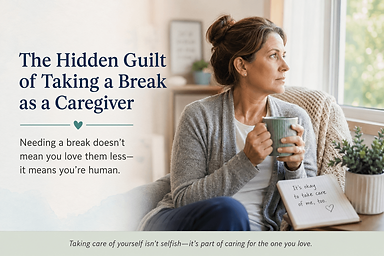
“If I take a break, does that mean I’m being selfish?”
It is a question many caregivers may think but rarely say out loud.
When someone you love depends on you, stepping away—even for a few hours—can feel wrong. You may finally sit down to rest, only to spend the entire time wondering whether they need you. Someone else may offer to help, yet instead of feeling relieved, you feel guilty for accepting.
You may find yourself thinking:
They need me.
I should be doing more.
What if something happens while I’m gone?
How can I take time for myself when they do not get a break from being sick?
This is caregiver guilt, one of the hidden emotional burdens that can come with caring for someone you love.
Sometimes, even rest can feel like something you have to feel guilty about.
But needing a break does not mean you love someone less.
And wanting a few hours when you are not actively caregiving does not mean you want a break from the person you love.
There is an important difference.
What Is Caregiver Guilt?
Caregiver guilt is the feeling that you are somehow not doing enough, giving enough, or sacrificing enough for the person in your care.
It can appear in many different ways.
You may feel guilty for leaving the house.
Guilty for feeling tired.
Guilty for becoming frustrated.
Guilty for asking someone else to help.
Guilty for enjoying yourself while your loved one is sick.
You may even feel guilty simply for wishing life were different.
These feelings can be especially difficult because caregiving is often rooted in love.
When you care deeply about someone, it can become easy to believe that being a good caregiver means always being available.
But no one can be available every moment without eventually becoming exhausted.
Recognizing caregiver guilt does not mean ignoring your responsibilities. It means recognizing that your needs still matter, even when someone you love needs you.
Why Do Caregivers Feel Guilty About Taking a Break?
Caregiving can gradually change the way you think about your own needs.
When another person relies on you for meals, medications, transportation, personal care, supervision, companionship, or everyday activities, their needs can begin to feel more important than everything else—including your own.
Over time, putting yourself last can become normal.
So when an opportunity to rest finally comes, caregiver guilt may quickly follow.
You may worry that no one else will care for your loved one exactly the way you do.
You may feel responsible for making sure they are comfortable every moment.
You may worry that something will happen while you are away.
Or you may believe that a “good caregiver” should be able to handle everything without needing help.
But caregiving is demanding precisely because you care.
Feeling tired does not erase that love.
Needing help does not erase it either.
“How Can I Take a Break When They Can’t?”
This may be one of the hardest forms of caregiver guilt to overcome.
Your loved one cannot take a day off from dementia, cancer, heart disease, COPD, Parkinson’s disease, or another serious illness.
So how can you justify taking a day—or even a few hours—away from caregiving?
The answer is that you and your loved one are experiencing two different realities, and both matter.
Their illness deserves compassion.
Your exhaustion deserves compassion, too.
Taking a break does not suggest that your experience is harder than theirs. It simply recognizes that caregiving requires physical, mental, and emotional energy.
Those resources are not unlimited.
You do not have to become completely exhausted before you are “allowed” to rest.
Caregiver Guilt Can Make Rest Feel Impossible
Sometimes caregivers technically get a break without actually experiencing one.
You leave the house but constantly check your phone.
You lie down but listen for every sound.
Someone offers to stay with your loved one, but you spend the entire time worrying about whether everything is being done correctly.
You finally have an afternoon to yourself—and use it to catch up on laundry, groceries, prescriptions, paperwork, and appointments.
That may be time away from direct caregiving.
But is it really rest?
Caregiver guilt can make it difficult to mentally step away even when someone else has taken over the physical responsibilities.
Real rest sometimes requires giving yourself permission, even briefly, to stop being responsible for everything.
That can be incredibly difficult when caregiving has become such a large part of your life.
You Can Love Someone and Still Feel Exhausted by Caregiving
Two things can be true at the same time.
You can love someone with your entire heart and feel exhausted by caregiving.
You can be grateful that you are able to care for them and wish you had more time for yourself.
You can want to be there for them and occasionally want to be somewhere else.
You can cherish your time together and miss the life you had before caregiving became necessary.
These feelings do not cancel each other out.
Caregiving can involve love, grief, frustration, tenderness, resentment, gratitude, exhaustion, fear, and joy—sometimes all within the same day.
Caregiver guilt often appears when we believe we should not have some of these feelings.
But having complicated emotions does not make your care less meaningful.
It makes you human.
Taking a Break From Caregiving Can Help You Continue Caring
Rest is often treated as something caregivers should do only after everything else is finished.
The problem is that in caregiving, everything is rarely finished.
There may always be another medication to organize, another appointment to schedule, another meal to prepare, another load of laundry, another phone call, or another concern running through your mind.
If you wait until there is absolutely nothing left to do before allowing yourself to rest, that moment may never come.
Taking a break from caregiving does not have to mean abandoning your responsibilities.
Regular breaks can give you opportunities to physically rest, mentally reset, reconnect with other parts of your life, and simply have moments when someone does not immediately need something from you.
Sometimes, allowing someone else to help is part of continuing to care.
A Break From Caregiving Does Not Have to Mean Leaving for an Entire Day
When people hear “take a break,” they may imagine vacations, spa days, or entire weekends away.
For many caregivers, that simply is not realistic.
A break can be much smaller.
It might mean:
Sitting outside alone with a cup of coffee
Taking an uninterrupted shower
Going for a short walk
Watching an episode of your favorite show
Having lunch with a friend
Going grocery shopping alone without rushing
Taking a nap while someone you trust stays nearby
Spending an hour doing something completely unrelated to caregiving
Small breaks still count.
The goal is not to escape your life.
It is to create moments within that life where you are allowed to exist as more than a caregiver.
Accepting Help Can Reduce Caregiver Stress and Guilt
Many caregivers hear the words:
“Let me know if you need anything.”
But actually accepting that help can be surprisingly difficult.
You may think it would take too long to explain everything.
You may worry your loved one will become upset if someone else helps.
You may feel uncomfortable asking.
Or caregiver guilt may convince you that you should be able to manage everything yourself.
Instead of waiting until you are overwhelmed, consider giving people specific ways to help.
Could someone bring dinner?
Pick up groceries?
Sit with your loved one for an hour?
Drive them to an appointment?
Mow the lawn?
Handle an errand?
Sometimes caregiving becomes more manageable not because there is less to do, but because one person is no longer trying to do all of it.
When Caregiver Guilt Contributes to Caregiver Burnout
Everyone has difficult days.
But repeatedly ignoring your own needs because you feel guilty stepping away can contribute to overwhelming caregiver stress and exhaustion.
Signs that you may need more support can include:
Feeling constantly exhausted
Becoming increasingly irritable or impatient
Feeling emotionally numb or disconnected
Losing interest in things you once enjoyed
Feeling overwhelmed by even small caregiving tasks
Neglecting your own medical appointments or health needs
Feeling as though you can never leave your loved one
Becoming resentful and then feeling guilty for that resentment
Feeling like caregiving has completely consumed your identity
These feelings do not mean you do not care enough.
They may mean that you have been carrying too much for too long.
Talking with your healthcare provider, your loved one’s care team, a counselor, caregiver support group, faith community, family members, or other trusted sources of support may help you identify ways to reduce some of that burden.
Respite Care Can Give Caregivers Time to Rest
Sometimes a caregiver needs more than a few minutes or an hour.
They need meaningful time to recover.
Respite care provides temporary relief for a primary caregiver by allowing someone else to take over caregiving responsibilities for a period of time.
Depending on your loved one’s situation and available resources, support may be available through family and friends, community organizations, adult day programs, professional in-home caregiving services, or other programs.
For eligible hospice patients, the Medicare hospice benefit may also provide short-term inpatient respite care in certain circumstances when the usual caregiver needs relief.
Using respite care does not mean you are abandoning your loved one.
It means caregiving becomes a shared responsibility for a period of time.
Sometimes, sharing that responsibility is exactly what allows a caregiver to continue.
What Would You Tell Another Caregiver Feeling Guilty?
If caregiver guilt still tells you that taking a break is selfish, imagine another caregiver came to you and said:
“I’m exhausted. I haven’t had time to myself in weeks. Someone offered to stay with my loved one for a few hours, but I feel terrible leaving.”
What would you tell them?
Would you tell them they were selfish?
Would you tell them they should feel guilty?
Would you tell them that if they truly loved their family member, they would never need a break?
Probably not.
You would probably tell them:
Go. Rest. They will be okay. You need care, too.
Now ask yourself another question:
Why is it so much easier to give another caregiver permission to rest than it is to give yourself the same permission?
Sometimes caregivers deserve to hear the same compassion they would so easily give someone else.
You Are Still a Person Outside of Caregiving
Caregiving may be an important part of your life.
But it is not the entirety of who you are.
You are still a spouse, parent, child, sibling, friend, coworker, neighbor—or simply yourself.
You still have interests.
You still have relationships.
You still have a body that needs sleep, food, movement, and medical care.
You still have emotions that need space.
You still deserve moments of laughter that have nothing to do with illness.
And you are allowed to have experiences that do not revolve around caregiving.
Caregiver guilt may tell you that focusing on yourself takes something away from the person you care for.
It does not have to.
Sometimes, taking care of yourself gives something back to both of you.
The Next Time Caregiver Guilt Tells You Not to Take a Break
You may not be able to make caregiver guilt disappear completely.
But you can begin questioning what it tells you.
When guilt says:
“I should be there.”
Remind yourself:
“They are safe, and I am allowed to rest.”
When guilt says:
“I should be able to handle this myself.”
Remind yourself:
“No one is meant to do everything alone.”
When guilt says:
“Someone else won’t do it the way I do.”
Remind yourself:
“Different does not always mean wrong.”
And when guilt says:
“Taking a break means I’m selfish.”
Remind yourself:
“Taking care of myself does not mean I have stopped caring for them.”
You do not have to wait until you are completely burned out to deserve a break.
You do not have to prove how much you love someone by exhausting yourself.
And you do not have to feel guilty for needing moments when you can simply be you again.
Because needing a break from caregiving is not the same thing as wanting a break from the person you love.
Sometimes, it is simply what helps you keep showing up.
Frequently Asked Questions About Caregiver Guilt
Is it normal to feel guilty about taking a break from caregiving?
Yes. Caregiver guilt is common, especially when a loved one depends heavily on you. You may worry about leaving them, feel that you should be doing more, or believe that taking time for yourself is selfish. Needing rest does not mean you care any less about your loved one.
Why do I feel guilty when someone else cares for my loved one?
You may be accustomed to being responsible for your loved one’s daily needs and feel that no one else will care for them exactly as you do. Giving up some control can feel uncomfortable. Accepting trusted help, however, can give you needed time to rest while allowing caregiving responsibilities to be shared.
Is it selfish for a caregiver to take a break?
Taking reasonable breaks from caregiving is not selfish. Caregiving can be physically and emotionally demanding, and everyone has limits. Time to rest, attend to your own needs, or reconnect with other parts of your life can be an important part of managing the demands of caregiving.
How do I stop feeling caregiver guilt?
Caregiver guilt may not disappear immediately, but it can help to recognize unrealistic expectations, accept appropriate help, set reasonable boundaries, and remind yourself that you cannot meet every need every moment. Talking with other caregivers, a counselor, healthcare professional, support group, or trusted person may also help.
What are signs that I may need a break from caregiving?
You may need additional support if you feel constantly exhausted, increasingly irritable, overwhelmed, emotionally disconnected, resentful, or unable to care for your own health and basic needs. These can be signs that caregiving demands have become difficult to manage without more support.
What is respite care for caregivers?
Respite care provides temporary relief from caregiving responsibilities. Depending on the situation, respite may be provided by family members, friends, community programs, professional caregivers, adult day programs, or other services. Eligible hospice patients may also have access to short-term inpatient respite care under certain circumstances.
To Conclude
Caregiver guilt can make taking a break feel selfish, but needing rest does not mean you love or care for your loved one any less. You can be deeply committed to someone’s care while also recognizing that your own needs matter. You do not have to prove your love through exhaustion or wait until you are completely overwhelmed to accept help. Taking a break from caregiving is not the same as taking a break from the person you love—sometimes, it is simply what helps you continue showing up with the care, patience, and compassion you want to give.
Caregiving can bring many emotional, physical, and practical challenges, and you do not have to navigate them without support. Explore these additional resources for helpful guidance, reassurance, and answers to common questions caregivers face along the way.
Am I Doing This Right? Reassurance for Family Caregivers Who Feel Like They're Failing
What Happens When a Family Caregiver Gets Sick? A Guide for Families Facing the Unexpected
Tiny Gestures of Love: How Families Can Comfort Loved Ones with Small Acts
How to Nurture Your Well-Being: Essential Self-Care Strategies for Caregivers
How Love Languages Strengthen Caregiver and Family Relationships
Looking for more helpful information? Explore our Hospice Education, Health & Disease Education, Community Resources, and Emotional Wellness & Support categories for compassionate guidance, practical resources, emotional support and answers to common questions about hospice care, caregiving, chronic illness, and the end-of-life journey.

Why Families Trust Oasis Hospice:
Oasis Hospice has been recognized as one of the highest-rated hospice providers based on Medicare.gov quality ratings. Families searching for compassionate, high-quality hospice support can compare hospice providers and learn more through Medicare.gov Care Compare. For additional education, caregiving guidance, and end-of-life support resources, families may also find helpful information through the Hospice Foundation of America.
From Houston to Huntsville, Houston to Livingston, and the many communities in between, Oasis Hospice is committed to providing compassionate hospice care, guidance, and support for patients and families during life’s most difficult moments. If you or a loved one have questions about hospice support services, Oasis Hospice is here to help families throughout Southeast Texas navigate care with compassion, dignity, and guidance every step of the way. To learn more about our hospice services and family support resources, please visit our website below.
Explore more hospice resources, support, and articles here:


Comments